
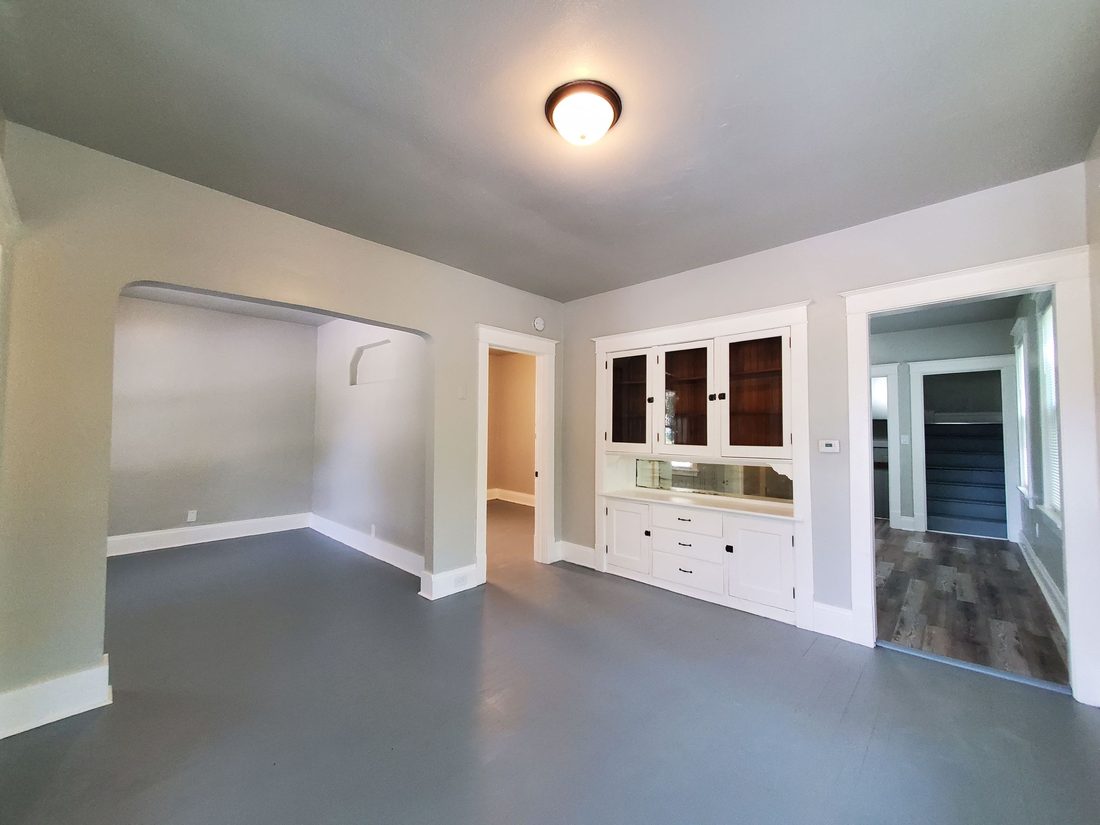
Most of the advice written for home sellers assumes somebody is living in the house. A great deal of it stops making sense the moment nobody is. An empty house in Milwaukee is not simply a house with less furniture in it — it sits in a different position with the City, with your insurer, and with the weather, and each of those three has its own clock running.
This is the situation behind a large share of the calls we take. A parent died and the house has been sitting since the funeral. The last tenants moved out and the turnover never happened. A job moved someone to Texas in March and the house did not sell before they left. In every one of those cases the property is fine on the day it empties out, and the costs start accruing quietly from the following week.
Why a Vacant House Is a Different Sale
Three things change when the last person walks out.
The first is regulatory. The City of Milwaukee treats vacant buildings as a category of their own, with a registration requirement attached, and it enforces that requirement through the mechanism it uses for everything else — your tax bill.
The second is contractual. Your homeowners policy almost certainly contains language about vacancy that you have never read, and it is the part of the policy most likely to matter to you this year.
The third is physical. Nothing in an empty house is being noticed. A slow leak in an occupied house is a stain on a ceiling and a phone call. In an empty house it is a fortnight of water running into a floor cavity before anyone opens the door.
None of this makes a vacant house unsellable. It makes it a house with a timeline, and the sellers who do well are the ones who work out what that timeline is early rather than discovering it in November.
Milwaukee Requires You to Register a Vacant Building
This is the item most owners have never heard of, and it is the one with a specific deadline attached.
Under the City of Milwaukee's vacant building ordinance (Milwaukee Code of Ordinances 200-51.7), a vacant building is to be registered with the Department of Neighborhood Services once it has been vacant for 30 days. Registration is done on the City's vacant building registration form, and each registration runs for a six-month period, with renewal required after that.
The registration process exists so the City knows who is responsible for a building that nobody is watching. That is a reasonable objective, and it is worth understanding that the ordinance is aimed at absentee neglect rather than at you personally. But the obligation is the obligation whether or not it was written with you in mind.
“For Sale” Is Not an Exemption
The assumption we hear most often is that putting the house on the market suspends all of this — that a property being actively marketed is obviously not an abandoned building and so the ordinance does not apply.
The City addresses that assumption directly, and the answer is no. Listing a building for sale does not exempt the owner from the requirement to register it as vacant. A house that has been on the market for seven months is still a house that has been vacant for seven months.
There is an exemption that does bite: a building undergoing active renovation, with all the required building permits obtained, is treated differently. That exemption is doing real work in a city with as much rehab activity as Milwaukee — but note the two conditions. Active, and permitted. An intention to renovate is not a renovation, and unpermitted work is not going to help you here of all places.
What Registration Actually Involves
It is a form, not an ordeal. The initial six-month registration is currently free; renewals carry a fee, and the City sets that fee by ordinance and adjusts it periodically, so confirm the current figure rather than relying on a number you read somewhere. Registration also puts the building on the City's radar for inspection.
Call DNS at (414) 286-3838 and ask what applies to your address. It is a short conversation, and it is a great deal shorter than the one that starts with a citation.
Unpaid City Charges Ride Along on Your Tax Bill
Milwaukee's enforcement mechanism for almost everything in this article is the same, and it is worth stating once so the rest makes sense.
City charges that go unpaid do not sit in a separate collections process indefinitely. They are added to the property tax bill as special charges. Vacant building inspection fees are assessed and collected as a special charge against the real estate. If the City boards up an open building, the board-up cost is charged. If the City ends up razing a building, Wis. Stat. § 66.0413(1)(f) allows the municipality to recover the cost as a lien on the real estate, assessed and collected as a special charge.
The timing detail that catches people: fees still unpaid when the annual tax roll closes in October are added to that year's tax bill, and once they are on the roll there is no appeal to get them off. An owner who was disputing a fee in September can find it has become a tax obligation in November.
This also means special charges surface on a title search, and they get paid at closing out of the proceeds. That is a solvable problem. It is simply a smaller problem in July than in December. We covered how special charges interact with delinquent taxes in our guide to Wisconsin property tax forfeiture and the Tyler case.
Your Insurance May Already Have Stopped Covering the House
If you take one thing from this article, take this one, because it is the item with the largest downside and it costs nothing to check.
Most standard homeowners policies contain a vacancy provision. It does not cancel your policy. It quietly removes or restricts specific coverages once the dwelling has been vacant beyond a defined period. On widely used policy forms that period is 60 consecutive days; some carriers use 30. The coverages that typically fall away are the ones you would most want on an empty house — vandalism and malicious mischief, glass breakage, and certain categories of water damage.
Read that sequence again in the order it actually happens. The house empties out. Sixty days pass. Somebody breaks a basement window in the ninth week and strips the copper. You file a claim, and the vandalism coverage is the coverage the vacancy provision suspended.
Vacant and Unoccupied Are Not the Same Word
Insurers generally distinguish between the two. Unoccupied means nobody is living there but the contents are still in place. Vacant means empty of people and belongings both. The vacancy provisions in many policies key off the emptier condition.
The practical consequence is worth spelling out, because it catches families settling an estate more than anyone else. The house is unoccupied for four months while everyone works out what to do, and the coverage position is largely intact. Then the cleanout happens over a weekend, the last of the furniture goes, and the clock that matters starts running — usually without anyone realising a line has been crossed.
What to Do Instead
Call your agent. Say the words “the house is now vacant” and ask what your policy requires. Do not send an email and assume silence is agreement.
There are generally two routes: a vacancy endorsement added to the existing policy, or a separate vacant-property policy. Both cost more than what you are paying now, and both cost enormously less than an uncovered fire. Whichever route you take, get the answer in writing.
The mistake to avoid is the tempting one: saying nothing, on the theory that what the insurer does not know cannot hurt you. Non-disclosure is the reason claims get denied. The insurer finds out at exactly the moment you need them not to.
The Clock You Are Actually Racing Is Winter
It is early August as this is written, which means Milwaukee homeowners have roughly three months of comfortable decision-making left and then the season makes the decision for them.
A vacant house going into a Wisconsin winter has one dominant risk, and it is not the roof or the furnace. It is a frozen supply line. Water expands when it freezes, the pipe splits, and then it thaws — and a split pipe under pressure in an empty house discharges continuously until somebody notices. The damage is rarely the plumbing repair. It is the floors, the ceilings below, the framing, and eventually mould.
You have two legitimate options and one bad one.
- Keep the heat on. The commonly cited minimum is 55°F. This means keeping the gas on and the account live all winter, and it means somebody physically checking the house, because a furnace that fails in January in an unwatched house has achieved nothing.
- Shut the water off and drain the system properly. Close the main, open the fixtures, drain the lines and the water heater, and deal with the traps. Done properly this is the more robust option for a house that will sit for months. Done half-way — the main closed but standing water left in the lines — it is not protection at all.
- Do nothing and hope the sale closes first. This is the one that generates the phone calls we get in February. A closing date is not a plan; it is a forecast.
If the house is going to sit through a Milwaukee winter, decide in September which of the first two you are doing and put a person's name against it.
What Actually Goes Wrong in an Empty Milwaukee House
Not theory — the recurring list, in rough order of how often we walk into it.
- Water, in every form. Frozen and burst lines, a failed water heater, a sump pump that stopped when the power was cut, a downspout that came loose and pushed water at the foundation for a season. Water is far and away the leader.
- Copper and scrap. An empty house that looks empty attracts attention. Plumbing, wiring, furnace, water heater, appliances, and the copper downspouts on the older stock.
- Squatting and unauthorised entry. Uncommon but not rare, and expensive on both the removal side and the condition side.
- Roof and gutters. Nobody clears a gutter on a house nobody visits. Ice dams form, water backs up under the shingles, and one winter of that turns a small roof repair into a roof and a ceiling.
- The exterior. Long grass and an uncleared walk are the two things a neighbour reports, and they are the fastest route to a City inspection you did not ask for.
- Mail and packages piling up. The clearest possible signal that nobody is coming. Forward the mail.
Most of these are cheap to prevent and expensive to fix, and every one of them is worse in a house nobody has been inside for six weeks.
Code Orders, Board-Ups, and the Raze Order
Vacant buildings draw inspection attention. That is the point of the registration programme. What follows an inspection is an order to correct, with a deadline.
If a vacant building is open to entry, the City can board it up and charge the cost. Board-up work in Milwaukee is requested by the DNS inspector and carried out by City crews, and the charge is assessed directly against the property.
At the far end of the scale is the raze order. Under Wis. Stat. § 66.0413(1)(b)1, a municipality's governing body or building inspector may order a building razed where it is old, dilapidated or out of repair and consequently dangerous, unsafe, unsanitary or otherwise unfit for human habitation, and unreasonable to repair. Subsection (1)(c) supplies the test for “unreasonable”: repairs are presumed unreasonable when the cost exceeds a threshold calculated from the building's assessed value. An owner or other affected party can apply to the circuit court to restrain a raze order under (1)(h), and the court decides whether the order is reasonable. If the owner does not comply, subsection (1)(f) lets the municipality raze the building and recover the cost as a lien and special charge.
We are not raising this to alarm anyone. A house that has been empty since March is nowhere near a raze order. We raise it because it is the endpoint of the path, and knowing the path has an endpoint is what makes it obvious that a vacant building is not a stable state you can leave indefinitely. It either gets occupied, gets renovated, or gets sold.
The Certificate of Code Compliance Still Applies
Wisconsin has no statewide point-of-sale inspection requirement, which leads a lot of sellers to assume there is nothing to do. Inside the City of Milwaukee that assumption is wrong, and vacancy tends to put you on the wrong side of it.
The City of Milwaukee requires a Certificate of Code Compliance at the time of sale for all non-owner-occupied one- and two-family dwellings city-wide, and for owner-occupied one- and two-family dwellings in the six designated code compliance areas. The inspection is carried out by the Department of Neighborhood Services and the application fee is $75 per residential building.
A house that has stood empty for a year is not going to be treated as owner-occupied. The City's guidance puts the duty on the seller to inform prospective buyers of the requirement and the responsibility on the buyer to obtain the certificate, but do not plan a timeline around that division without confirming it for your parcel — call DNS. The inspection can surface orders, and orders take time.
Outside the city limits, every suburb sets its own rules. Wauwatosa, West Allis, Greenfield, Oak Creek and the rest are not interchangeable, and some have no pre-sale requirement at all. Ring your own municipality. Our fuller treatment of pre-sale disclosure and inspection is in the guide to Wisconsin's Real Estate Condition Report — and note that if you are selling as a personal representative or trustee who never lived in the house, you may be exempt from the condition report entirely.
Vacancy and Delinquent Taxes Compound Each Other
Vacant houses and unpaid property taxes travel together, for an unremarkable reason: the events that empty a house — a death, a move, a tenant leaving — are the same events that interrupt whoever was paying the bills.
If there was a mortgage with an escrow account and the mortgage has been paid off or the escrow closed, the tax bill lands on a person rather than a servicer, and it lands at an address that may no longer be checked. Meanwhile the City's vacant building fees and any inspection charges are being added to the same bill.
The good news is that none of this stops a sale. Delinquent taxes and special charges are paid from the proceeds at closing, in the same motion as a mortgage payoff. The bad news is that interest and penalties accrue the whole time you are deciding. Our guide to delinquent property taxes in Wisconsin covers the forfeiture timeline in detail, and if you are already behind, the selling with a tax lien page explains how the closing handles it.
If the House Is Empty Because Someone Died
This is the most common version of the vacant house, and it comes with an extra constraint: for a period, often nobody has the legal authority to sell.
Whether the property needs to go through probate at all depends on how the deed was written — joint tenancy with right of survivorship, a transfer on death deed, or a trust can each move the property without probate. Where probate is required, someone must be appointed before a deed can be signed, and that appointment takes as long as it takes.
What matters for this article is that the house does not pause while the paperwork proceeds. The 30-day vacancy clock, the insurance vacancy provision and the first freeze are all indifferent to whether an estate has been opened. So do the two things that do not require authority: tell the insurer the house is unoccupied, and make sure somebody is physically checking it.
Our Wisconsin probate and inherited property guide covers the ownership question in full, and the selling an inherited house page covers how we work around a probate timeline.
If the House Is Empty Because the Tenants Left
The other common version. A tenant moves out, the turnover is bigger than expected, and the unit sits — and a landlord who has decided they are done is now paying to hold an asset that produces nothing.
An empty unit is genuinely simpler to sell than an occupied one: no showings to coordinate around a tenant's schedule, no lease for a buyer to take subject to, no security deposit to transfer. What it costs you is the holding period and the vacancy exposure described above.
The honest arithmetic for a landlord at this point is a comparison between the cost of the turnover plus the months to re-let, and simply exiting. We wrote up a vacant Milwaukee rental we bought where the owner ran exactly that comparison, and the selling a rental property page covers the tenant-occupied case if the unit is not actually empty.
If You Live Out of State
Distance is what turns a manageable vacant house into an expensive one, because every item on the list above assumes somebody can get to the property.
If you are managing a Milwaukee house from another state, you need three things settled: a named person who can physically access the house, a written answer from your insurer about vacancy, and a decision about winter made before October. A neighbour with a key is worth more than any of the remote monitoring you can buy, though a cheap temperature sensor that texts you when the house drops below 45°F is a good second line.
The alternative is not to hold it. Selling from out of state is routine — we handle access ourselves and closings are done at a local title company, with remote or mobile notary arrangements where you cannot travel. The relocating sellers page covers the timeline side.
What Vacancy Does to a Traditional Listing
Listing a vacant house is entirely possible and often the right call. It is worth being clear-eyed about what changes.
Empty rooms show smaller and read colder than furnished ones, which is why staging exists and why it costs what it does. Buyers read vacancy as motivation, and price their offers accordingly. And a financed buyer brings a lender, and a lender brings an appraiser who will notice anything the vacancy has caused — a water stain, a dead furnace, peeling paint on a pre-1978 house for an FHA or VA appraisal. Those become conditions of closing, on a house you are already paying to hold.
Meanwhile the meter runs the whole time. Taxes, insurance at the higher vacant rate, utilities kept on to protect the plumbing, lawn and snow service, and the risk exposure. Two months on market is a real number; four is common on a house that needs work.
Our cash buyer versus realtor comparison runs that arithmetic properly, and the compare your options page sets the routes side by side. For a house in decent condition in a strong neighbourhood, listing frequently wins even after the holding costs. For a vacant house that needs work, the gap narrows fast.
What It Costs to Hold a Vacant House
Sellers routinely underestimate this, because most of it is money that was going out anyway.
The recurring items are property taxes, insurance at the vacant rate rather than the owner-occupied rate, utilities you cannot switch off because the plumbing depends on them, lawn cutting in summer and snow clearing in winter, and any mortgage still in place. To that add the periodic items: the City registration and any inspection fees, and whatever the first thing to go wrong costs.
We are not going to invent a monthly figure for you, because it depends entirely on your house and your tax bill. What we would suggest is doing the arithmetic properly for your own property before deciding to wait for a better market. Add the monthly items, multiply by the number of months you realistically expect, and compare that against the difference between a cash offer and what you think you would net from a listing after commission, concessions and repairs. Sometimes waiting clearly wins. Sometimes the holding cost eats the entire difference, and people are surprised how often that is the case on a house that needs work.
What Selling to a Cash Buyer Changes
To be straightforward about our own interest here: we buy houses, and a vacant house is much closer to our normal case than our exception.
What changes practically is that most of the vacancy problem stops being your problem on the closing date. There is no lender and therefore no appraiser to satisfy about condition. Nothing needs cleaning out — belongings left behind are genuinely fine, and we would rather you did not spend a weekend on a skip hire. No staging, no showings, no keeping the house presentable for a market you are not in. The closing date is one you choose, which means you can put it before the freeze rather than hoping.
What you give up is price. A cash offer on a house that needs work is below what that house would fetch listed and repaired, and anybody who tells you otherwise is selling something. The question is never “which number is bigger” — it is what you net after commission, repairs, concessions and the months of holding cost, and how much the certainty is worth to you. On an occupied house in good order the listing usually wins that comparison. On a vacant house that needs work and is heading into a Wisconsin winter, it often does not. We will tell you which one we think you are, including when the answer is that you should list it. The sell as-is page and our frequently asked questions cover how the offer is built.
Closing Costs and the Wisconsin Transfer Fee
One number worth knowing whichever route you take, because it applies to every conveyance in the state.
Wisconsin imposes a real estate transfer fee of 30 cents per $100 of value — $3 per $1,000 — on conveyances, under Wis. Stat. § 77.22. The fee obligation sits with the grantor, meaning the seller, and an eTransfer return is submitted with the deed when it is recorded. On a $150,000 sale that is $450.
Add title work, any payoffs, and the pro-rated share of the property taxes, and you have the shape of a Wisconsin closing statement. In our own purchases we cover the closing costs, including the transfer fee, and no commission is charged — the offer figure is the figure at the table. Delinquent taxes, special charges and municipal liens are paid out of the proceeds; they reduce what you receive rather than blocking the sale.
A Practical Order of Operations
If your house is empty right now, the sequence below solves most of it in a fortnight.
- Call your insurer and use the word vacant. Ask what the policy requires and get the answer in writing. Nothing else on this list has the same downside.
- Call DNS on (414) 286-3838 and ask whether the property needs a vacant building registration and whether a Certificate of Code Compliance will be required at sale.
- Confirm who has authority to sign a deed, particularly on an estate. There is no point planning a sale nobody can execute.
- Pull the tax and charge position. Check the current balance, whether anything has been added as a special charge, and where the bill is being posted.
- Decide winter now, not in November. Heat at 55°F with someone checking, or water off and lines drained. Put a name against it.
- Arrange eyes on the house. Weekly if you can. A neighbour, a relative, a service — anything better than nobody.
- Forward the mail and keep the exterior tidy. The two cheapest ways to stop the house announcing that it is empty.
- Then decide how you are selling, with the holding cost written down rather than estimated in your head.
The Short Version
An empty Milwaukee house is on a clock that most owners do not know is running. The City wants it registered after 30 days and does not accept a For Sale sign as an answer. Your insurer has probably narrowed your coverage already. Anything the City ends up paying for lands on your tax bill, and after the roll closes in October it cannot be appealed off. And the first hard freeze does not care what stage your sale is at.
None of that makes the house hard to sell. It makes waiting expensive. Make the two phone calls this week, decide winter before September ends, and then choose your route with the real numbers in front of you. We buy vacant houses across the Milwaukee metro in any condition, and we are happy to tell you when listing is the better move — the before-and-after projects will give you a fair sense of the condition we are used to.
Selling a Vacant House in Milwaukee — Common Questions
Do I have to register my house with the City of Milwaukee if it is empty while I try to sell it?
Probably yes, and listing it for sale does not get you out of it. Under the City's vacant building ordinance (Milwaukee Code of Ordinances 200-51.7) a vacant building is to be registered with the Department of Neighborhood Services once it has been vacant for 30 days, and the City states plainly that marketing a building “For Sale” is not an exemption. A building under active renovation with all required permits pulled is treated differently. Call DNS at (414) 286-3838 to confirm what applies to your parcel.
Does my homeowners insurance still cover the house once nobody lives there?
Often not fully. Most standard homeowners policies contain a vacancy provision that suspends or removes certain coverages once the dwelling has been vacant beyond a set period — commonly 60 consecutive days on widely used policy forms, and 30 days with some carriers. Vandalism, malicious mischief, glass breakage and some water damage are the coverages that typically fall away first. Call your agent and ask specifically what your policy says about vacancy rather than assuming you are covered.
What is the difference between a vacant house and an unoccupied one?
Insurers generally treat “unoccupied” as nobody living there but the furniture and belongings still in place, and “vacant” as empty of both people and contents. The distinction matters because the vacancy provisions in many policies are triggered by the emptier of the two. This is exactly why an estate cleanout can quietly change your coverage position — the house was unoccupied on Monday and vacant on Friday.
I am selling this autumn. Do I still need to winterise?
Assume yes unless the sale closes before the first hard freeze, and do not build a plan around a closing date that has not happened yet. Either keep the heat on at a minimum temperature — 55°F is the figure most plumbers use — or shut the water off at the main and have the system properly drained. A burst supply line in an empty Milwaukee house can run unnoticed for weeks, and it is the single most common way a sellable house becomes a much harder one.
Can the City of Milwaukee make me demolish a vacant house?
It can order a building razed in defined circumstances. Under Wis. Stat. § 66.0413(1)(b)1 a municipality may order razing where a building is old, dilapidated or out of repair and consequently dangerous, unsafe, unsanitary or otherwise unfit for human habitation and unreasonable to repair, and § 66.0413(1)(c) presumes repair is unreasonable once the cost exceeds a threshold tied to the building's assessed value. An owner can apply to the circuit court to restrain a raze order under § 66.0413(1)(h). If the owner does not comply, the municipality may raze the building and recover the cost as a lien and special charge against the property. This is a rare endpoint, not a routine one — but it is why an unaddressed vacant building is not a stable situation.
Does Milwaukee's Certificate of Code Compliance apply to a vacant house?
The requirement turns on how the property is classified rather than on whether anyone is currently living in it. The City of Milwaukee requires a Certificate of Code Compliance at the time of sale for all non-owner-occupied one- and two-family dwellings city-wide, and for owner-occupied one- and two-family dwellings in the six designated code compliance areas. The application fee is $75 per residential building. A long-vacant house is very unlikely to read as owner-occupied, so plan on it. Confirm your parcel with DNS at (414) 286-3838.
Can I sell a vacant house that already has open code violations or unpaid City charges?
Yes. Open orders and unpaid municipal charges do not freeze a sale — they get dealt with at closing, the same way a mortgage payoff or a delinquent tax balance is. What you should not do is let them accumulate quietly in the meantime, because unpaid City fees that are still outstanding when the tax roll closes in October are added to the annual tax bill, and once they are on the roll there is no route to appeal them off.
The house is vacant because a parent died. Where do I start?
Start with authority and insurance, in that order. Find out whether anyone currently has legal authority to act for the estate, because until someone does, nobody can sign a deed. Then call the insurer, tell them the house is now unoccupied, and ask what the policy requires. Those two calls, made in the first fortnight, prevent most of the expensive problems. Our guide to Wisconsin probate and inherited property walks through the rest.
Do you buy vacant houses in Milwaukee?
Regularly — a vacant house is much closer to the normal case for us than the exception. We do not need the property cleaned out, staged, repaired, heated or shown, and there is no lender whose appraiser has to be satisfied about the condition. If the house is standing empty and you are out of state, we can handle access and coordinate a remote closing with a local title company.